Why Roof Valleys Are Common Leak Areas
Published · Updated · 6 min read
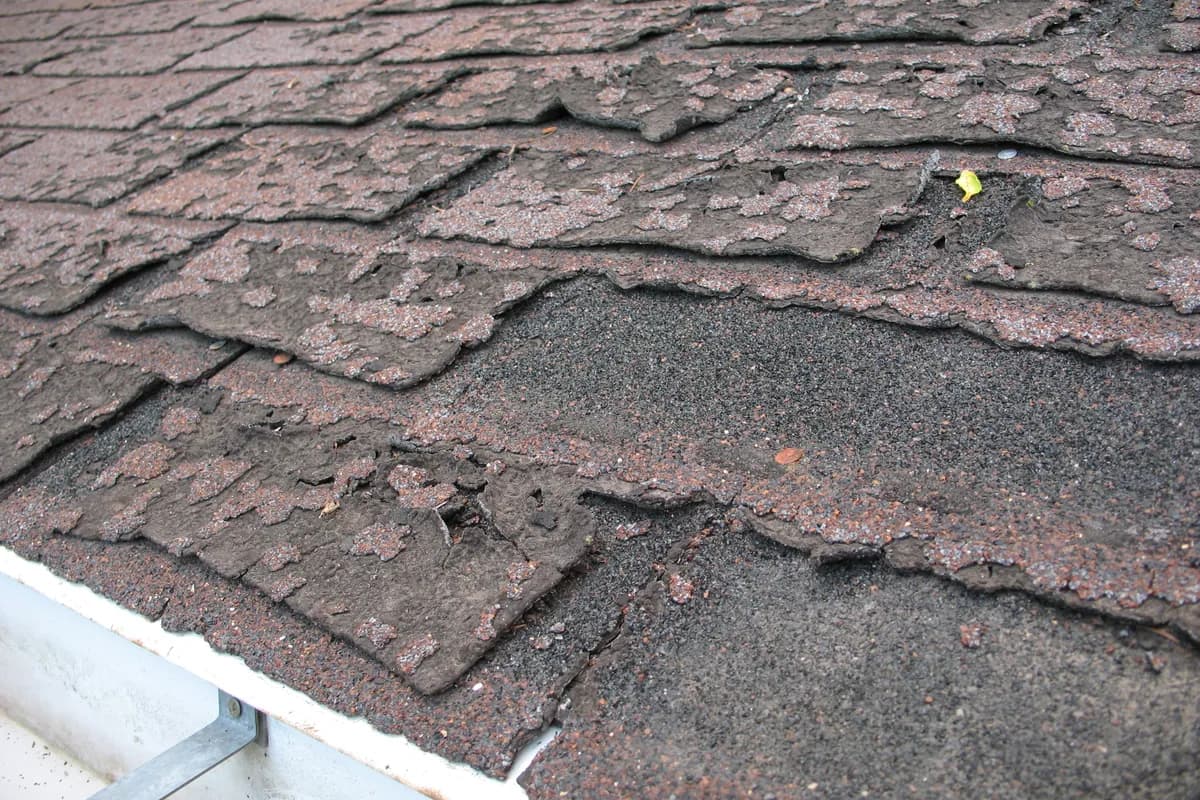
Photo: DMahalko, Dale Mahalko, Gilman, WI, USA -- Email: dmahalko@gmail.com / CC BY-SA 3.0, via Wikimedia Commons
Where two roof planes meet at an internal angle, they form a valley. Everything that falls on either of those planes is funnelled into it.
On the articulated roofs common in the later Burlington County subdivisions — multiple gables, dormers, bay projections, garages set at an angle — a single valley can end up carrying a very large share of the roof's total drainage. Concentrated flow, at speed, in a narrow channel, at the one place where the covering has to change direction.
Volume and velocity
The water arriving in a valley is not just greater in quantity — it is moving faster, because it has been accelerating down two slopes before it converges.
Fast, concentrated water behaves differently from a sheet running down a field of shingles. It scours granules from the surface, which is why valleys frequently show wear long before the rest of the roof. It also has enough momentum to jump sideways where the channel changes shape, or to be deflected under the courses on either side if something obstructs it.
The three ways valleys are built
An open valley leaves a metal channel exposed down the centre, with shingles cut back on either side. Water runs on the metal. It drains well, sheds debris more readily than the alternatives, and the metal is the wear surface rather than the shingle.
A closed-cut valley runs shingles from one plane across the valley, then cuts the shingles from the other plane back along a line just off centre. A woven valley interlaces courses from both planes across the centre. Both are common, both perform well when built correctly, and both put shingle rather than metal in the path of the water.
- Open valley — exposed metal channel, best debris shedding, visible detail
- Closed-cut valley — shingles across, cut back on one side; the most common today
- Woven valley — courses interlaced from both planes; no cut edge in the channel
What actually goes wrong
The single biggest cause of valley leaks is debris. A valley is where everything on the roof ends up, and once a mat of leaves or needles forms, water backs up behind it and spreads sideways under the shingles on either side — past a detail that only works when water stays in the channel.
The construction faults are more specific. In a closed-cut valley, nails placed too close to the centre put fasteners directly in the water path. A cut line that runs the wrong way relative to the flow lets water enter the cut edge. And in all types, valley underlayment that was omitted or stops short leaves the most concentrated flow on the roof running over ordinary felt.
Where the valley ends
The bottom of a valley gets less attention than it deserves. All that concentrated water has to leave the roof somewhere, and that point is usually a gutter.
If the gutter is blocked, or if the valley discharges at a point the gutter does not reach, water overshoots — running behind the gutter, down the fascia and onto whatever is below. On properties where one corner of the garden is permanently eroded, the cause is very often a valley discharging directly onto it.
Keeping a valley working
Valleys benefit more from maintenance than any other part of a roof, and it is mostly a matter of keeping them clear.
Clear them gently — a valley whose granules have already been scoured by years of flow does not need a stiff brush taking off what remains. And look at the whole length, including the top where a valley starts under a ridge and the bottom where it discharges.
Want someone to look at your roof?
Related services: Roof Repair, Roof Inspection, Gutter Services