How Flashing Protects Roof Penetrations
Published · Updated · 6 min read
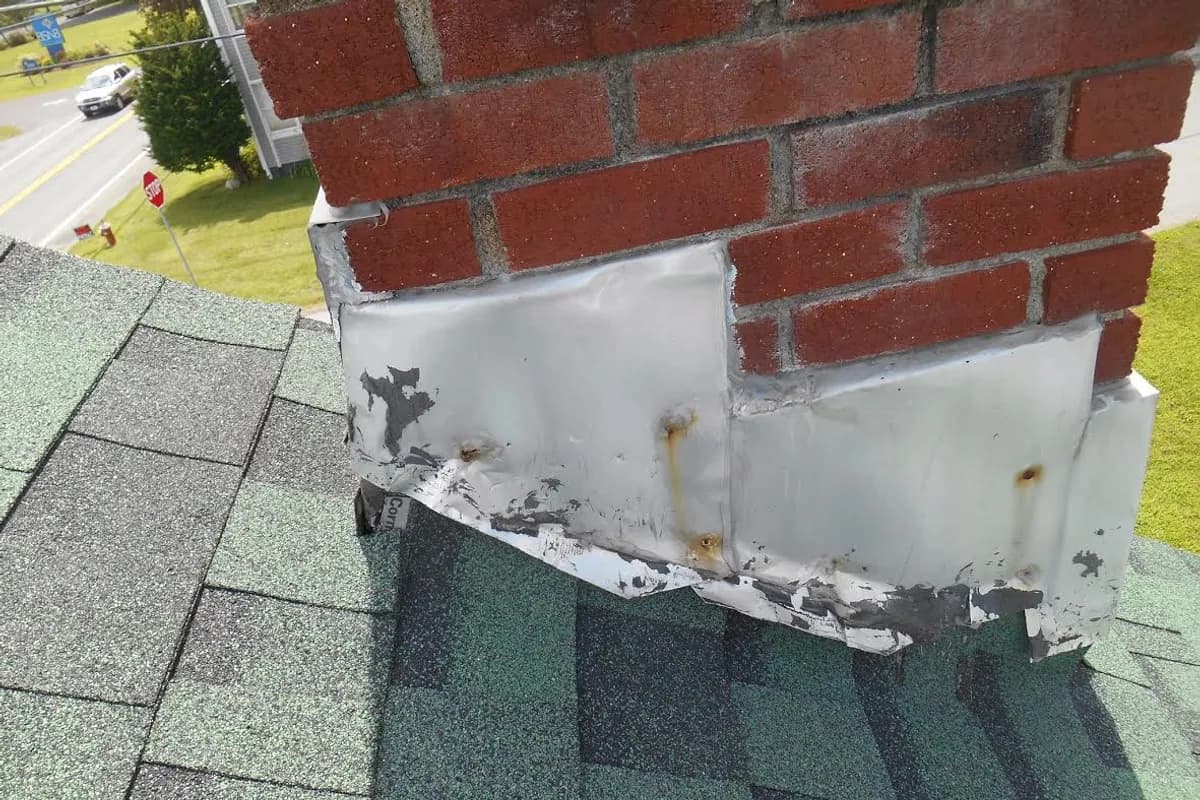
Photo: Sandul1234 / CC BY-SA 4.0, via Wikimedia Commons
Shingles handle the easy part of a roof: the open field, where water simply runs downhill over overlapping courses. The difficult part is everywhere the field is interrupted — by a chimney, a wall, a pipe, a skylight, a dormer.
Flashing is the metal that handles those interruptions, and it is where most roofs leak.
The principle: shed, do not seal
Good flashing works the way shingles do — by layering, so that each piece directs water onto the piece below it and eventually back onto the roof surface. Gravity does the work, and no component depends on an adhesive bond staying intact for decades.
That is the crucial distinction from sealing. A sealed joint is only as good as the sealant, and sealant degrades under UV and thermal movement. A shed joint keeps working after the sealant has failed, because the geometry is doing the job.
Step flashing at walls and dormers
Where a roof slope runs alongside a wall — a dormer cheek, the side of a chimney, an addition against the house — the correct detail is step flashing: individual L-shaped pieces, one per shingle course, each woven in so it laps the one below.
The common failure is a single continuous length of metal run up the whole junction instead. It looks tidy and it holds for a while, but it has no layering, and once water gets behind it at any point it runs the entire length. Step flashing nailed through its face rather than through its vertical leg is the other frequent fault — each fastener becomes a hole in the water path.
Chimneys, and why they are the worst offenders
A chimney needs four things working together: apron flashing at the front, step flashing up both sides, counter-flashing let into the masonry to cover the tops of the step pieces, and — on a wide chimney — a cricket behind it.
The cricket is the part most often missing. Without it, the back of the chimney is a dam: water running down the slope hits the masonry, spreads sideways and sits there. A cricket is a small ridged structure that splits the flow and sends it around each side instead. On a wide chimney it is not optional.
The other classic chimney failure is the roofing-cement repair. Cement smeared over a flashing joint dries, shrinks and cracks within a few seasons, and then holds water against the masonry rather than shedding it — worse than the original problem.
Pipe boots, the most common failure of all
Every plumbing vent through the roof has a boot: a metal or plastic base with a flexible collar that seals around the pipe. The collar is usually rubber or a synthetic equivalent, and it sits in full sun for its entire life.
It hardens, then cracks, typically well before the shingles around it are worn out. A split collar is one of the single most common causes of a leak on a roof in otherwise good condition, and replacing one is straightforward and cheap. It is worth checking every boot on a roof any time someone is up there.
Skylights
Skylights leak more often than anything else on a roof, largely because there are several things that can fail: the flashing kit around the curb, the head flashing above it, the seal of the unit itself, and the condensation that forms on the inside of the glass and is frequently mistaken for a leak.
Telling those apart matters, because the answers are completely different. Water appearing only in cold weather with no rain is condensation, not ingress, and re-flashing the skylight will not change it.
Checking the flashing on your own roof
From the ground with binoculars you can see a surprising amount: cement smeared around a chimney, metal that has lifted or separated, counter-flashing coming out of a mortar joint, a vent boot collar that is visibly split or missing.
If the flashing on your roof is mostly black sealant, it is worth finding out what is underneath it. That is usually a repair waiting to happen rather than one that has already been made.
Want someone to look at your roof?
Related services: Roof Repair, Roof Inspection, Roof Replacement