How Gutter Drainage Affects the Roof Edge
Published · Updated · 6 min read
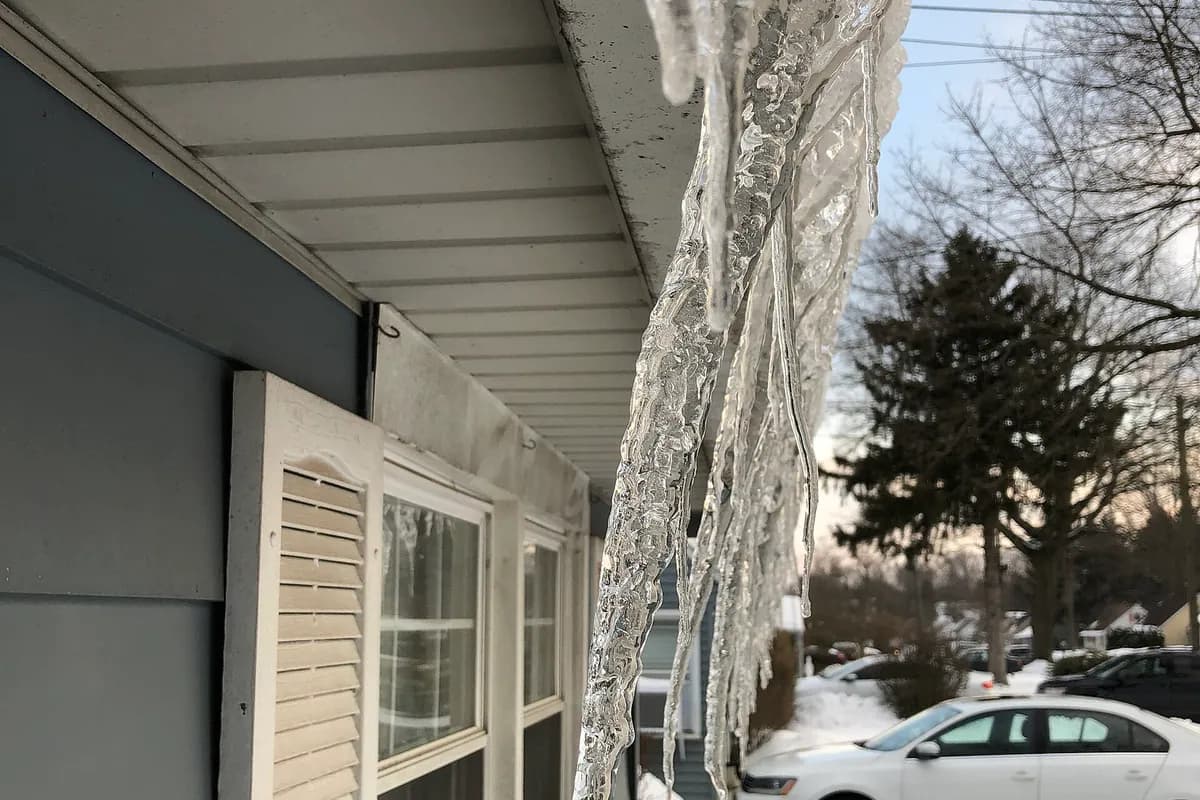
Photo: Famartin / CC BY-SA 4.0, via Wikimedia Commons
Gutters are treated as an accessory bolted to the building. In practice they are the last stage of the roof's drainage, and the roof edge is where the two systems meet.
When that junction fails, the damage happens in a place nobody looks: behind the gutter, on the fascia, at the ends of the rafters and at the very edge of the roof deck.
Overflowing forwards versus backing up
Water sheeting over the front lip of a gutter is untidy and it erodes the ground below, but it is the benign version. It lands outside the building.
The damaging version is water rising over the back edge — the side against the fascia. That happens when a gutter is full, hung at the wrong pitch, or blocked at the outlet. The water then goes onto the fascia board, behind the drip edge, and into the edge of the roof deck. From there it wicks inward along the sheathing, and nothing about it is visible until the fascia goes soft or a stain appears at the top of an interior wall.
Drip edge, and why sequence matters
The drip edge is the formed metal at the eaves and rakes. Its job is to carry water off the deck and into the gutter rather than letting it wick back underneath the shingle and onto the fascia.
The sequencing is specific and frequently got wrong: at the eaves the drip edge goes under the underlayment; at the rake it goes over. Installed the other way round, it channels water into the assembly instead of out of it. On older roofs it is often missing entirely, which is worth knowing if you have unexplained fascia rot.
Pitch, capacity and outlets
A gutter needs a consistent fall toward its outlet. Too little and water sits in it — which invites debris to settle and rot to start. Too much and it looks wrong and overshoots at the ends.
Capacity is the other half. Summer thunderstorms in this region deliver very high rainfall over a short period, and a gutter with too few downspouts will overwhelm regardless of how clean it is. If a gutter only overflows in the heaviest rain and is otherwise clear, the problem is capacity rather than blockage.
Where the water finally lands
A downspout discharging at the base of the wall concentrates a very large volume of roof water into the ground against the foundation. That is a basement and foundation problem that begins at the roof.
Extending downspouts, fitting splash blocks, or connecting into a drainage run that discharges well away from the building all solve it. It is inexpensive relative to the consequences and is routinely ignored.
Ice at the eaves
Ice forming in gutters and along the eave is usually blamed on the gutters. It is more accurately a symptom of heat escaping into the attic, melting snow higher up the roof, with the meltwater refreezing when it reaches the cold overhang.
A blocked gutter makes it worse by holding water where it can freeze, and eave membrane protects the roof edge when it happens. But the underlying fix is air sealing and ventilation — otherwise it recurs every winter regardless of how clean the gutters are.
A realistic maintenance interval
The right interval depends entirely on what is above the gutter, not on a generic schedule. Under mature deciduous trees — common across much of Burlington County — two or three clearances a year is realistic, and at least one of those should come after leaf fall has genuinely finished rather than in the middle of it.
On an open lot, once a year is often enough. Either way, the check that matters is running water through and confirming it reaches the outlet and leaves.
Want someone to look at your roof?
Related services: Gutter Services, Roof Repair, Roof Inspection