Flat Roof Drainage Problems Explained
Published · Updated · 6 min read
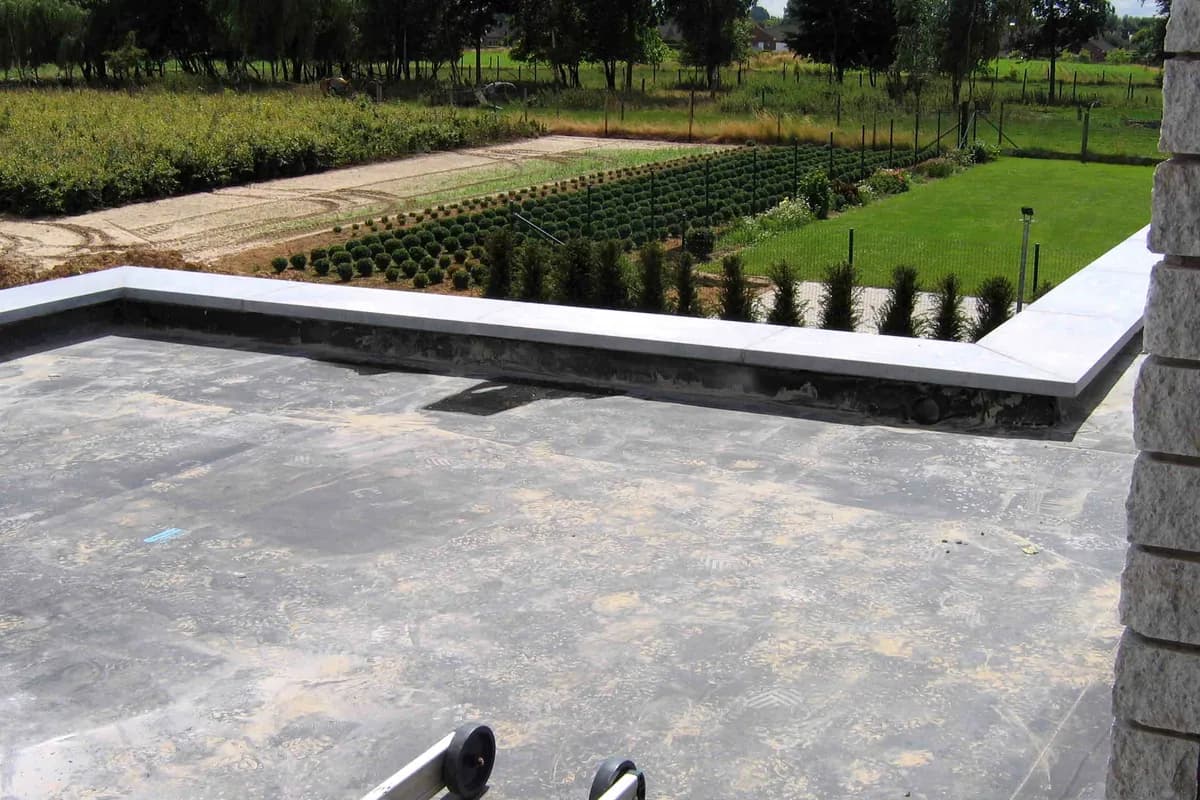
Photo: KVDP / Public domain, via Wikimedia Commons
A flat roof is not flat. It is built with a shallow fall toward defined outlets, and the whole system depends on water reaching those outlets and leaving.
When it does not, the membrane spends its life underwater rather than merely getting wet, and every seam and termination is under continuous pressure instead of occasional exposure.
Ponding, and the two-day rule
Water on a low-slope roof immediately after rain is expected. Water still standing forty-eight hours later is the industry's rough threshold for a problem, and it is a useful test for a building owner.
Standing water does several things at once: it keeps seams and terminations under constant hydrostatic pressure, it accelerates ageing of the membrane in that spot, it collects silt and debris that support growth, and in winter it freezes and expands. A ponding area is where the roof will fail first, and it is visible as a dark stain even when dry.
Three causes, three different answers
Ponding has three common causes and they are not interchangeable. The first is blockage — a drain strainer packed with debris, a scupper obstructed, a downspout disconnected during other work. That is maintenance, and it is the easiest to fix.
The second is deflection: the structure has sagged slightly between joists over time, creating a low point that is not where the drain is. The third is inadequate original fall, where the roof never had enough slope to drain properly. Both of the latter need tapered insulation or crickets to build fall back in, rather than anything done to the membrane.
- Blocked outlet — clear it, then check whether the water goes
- Structural deflection — a low point away from the drain
- Inadequate fall — the roof never drained properly to begin with
Internal drains and what sits below them
Internal drains are the usual arrangement on larger commercial roofs, and they have a failure mode that is easy to miss: the blockage is often below the roof, in the pipe, not at the strainer.
A drain that looks clear but drains slowly is worth investigating properly. So is the clamping ring at the drain, where the membrane is compressed to make the seal — a loose or missing ring lets water pass around the drain rather than into it, straight into the building.
Scuppers, edges and parapets
Scuppers — openings through a parapet wall that let water out at the edge — are simple and reliable when clear, and completely ineffective when blocked. Because they sit at the perimeter they collect wind-blown debris readily.
Parapet walls also create the roof's most demanding termination: the membrane must turn up the wall, be terminated at the top, and be protected by coping above. Failures here admit water into the wall itself, where it can travel a long way before appearing inside.
Why coating over a wet roof does not work
When a low-slope roof has been leaking for a while, water gets into the insulation beneath the membrane and stays there. Insulation does not drain.
A coating applied over that seals the water in. The insulation stays wet, loses its thermal value, continues to degrade the deck beneath, and the leak continues while the roof looks newly refurbished. This is why establishing whether the substrate is dry — by core sample or survey — has to come before any restoration recommendation.
What to check, and how often
Twice a year is the common rhythm on commercial low-slope roofs, plus after significant storms. Most of the value is simply in clearing outlets before autumn and confirming they still run.
On a residential porch or addition roof, the same logic applies at a smaller scale: keep the outlet clear, make sure the water is going where it is meant to, and look at the junction with the house wall, which is where these roofs almost always fail.
Want someone to look at your roof?
Related services: Flat Roofing, Commercial Roofing, Roof Inspection